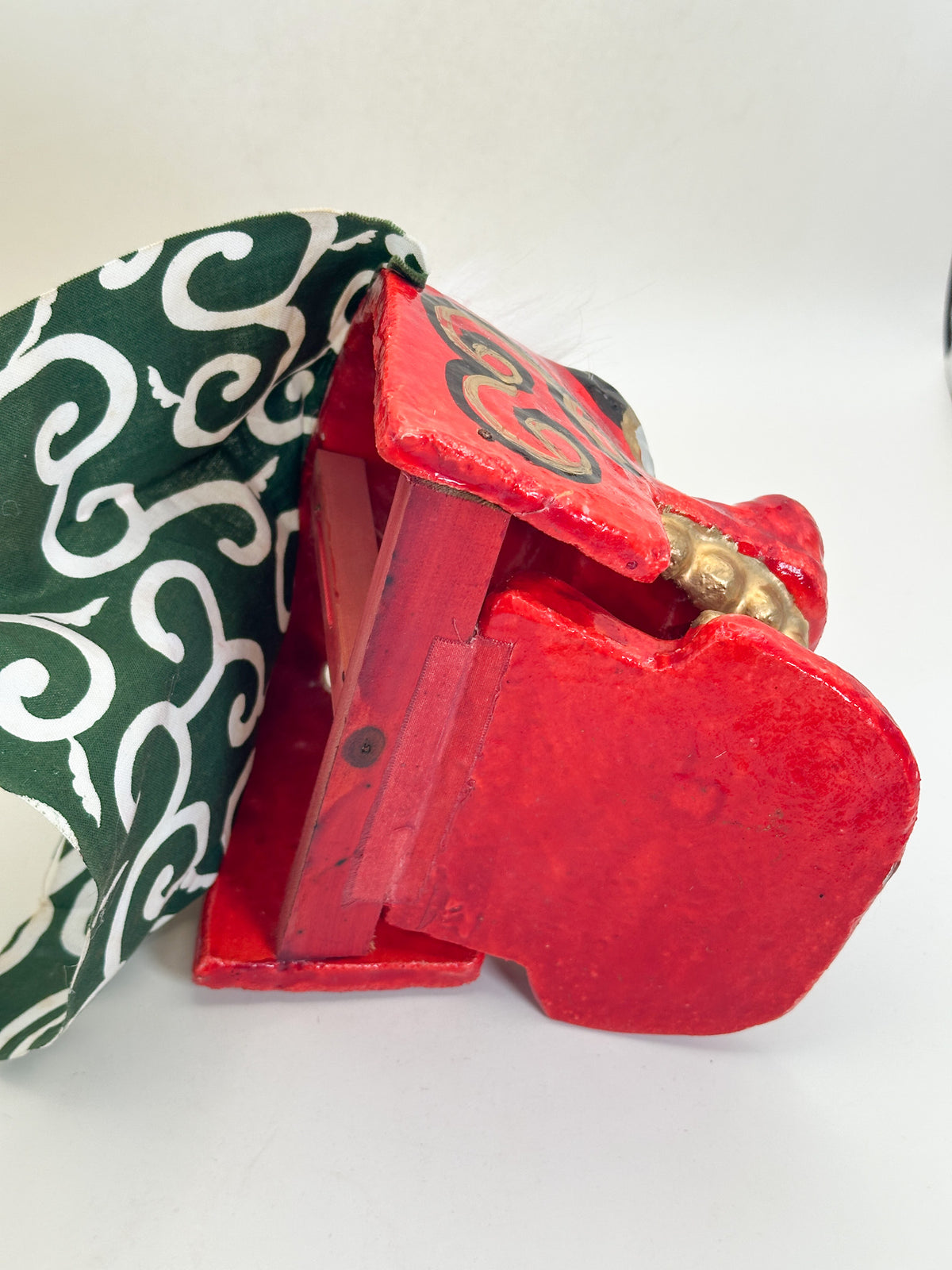
A striking Japanese hariko papier-mâché lion head, originating from Hyūga City, Miyazaki Prefecture (宮崎県日向市). This vivid red shishigashira (獅子頭) represents the Tenshō Shishi (天翔獅子), a distinctive lion associated with the sacred performing tradition of Ōmi Shrine (大御神社) in Hyūga.
The Tenshō Shishi tradition is unusually recent yet deeply rooted in Japanese Shinto symbolism. According to Ōmi Shrine, it originated in 1998, when the shrine priest, while performing purification in the sea at dawn, envisioned a magnificent lion racing through a sky illuminated red by the rising sun. Interpreting the vision as a revelation connected with the shrine's enshrined deity, Amaterasu Ōmikami (天照大御神), the lion was named Tenshō Shishi.
A new sacred lion dance was subsequently created and first offered before the deity during the shrine's festival in 1999. 大御神社 Traditionally, shishimai (獅子舞, lion dance) is performed at shrines, New Year celebrations and festivals as an auspicious performing art associated with driving away misfortune and inviting good fortune. The Tenshō Shishi was likewise created with prayers for yakunan shōjo (厄難消除) — protection from calamity — and kaiun shōfuku (開運招福) — opening the way to good fortune and happiness.
This decorative interpretation captures the powerful character of the performing lion with an expressive bright vermilion-red face, enormous staring eyes, black-and-gold brows, prominent nose and gilded teeth. Hand-painted swirling motifs decorate the sides, while a soft white mane and a flowing green-and-white patterned cloth complete its lively appearance. The slightly irregular modelling and hand-applied decoration give the piece the warm, individual character typical of Japanese papier-mâché folk craft.
More than simply a colourful folk ornament, this shishigashira carries the imagery of a very particular piece of Hyūga's contemporary local culture, connecting Japanese hariko craftsmanship with the protective and celebratory symbolism of the lion dance.
Size: 16 x 15 x 13cm